research findings
Filters
搜索

Chang, J., Tang, C. Y., & Zhu, Y. (2025+). Bayesian penalized empirical likelihood and Markov Chain Monte Carlo sampling. Journal of the Royal Statistical Society Series B, in press.

We propose a two-step procedure to model and predict high-dimensional functional time series, where the number of function-valued time series p is large in relation to the length of time series n. Our first step performs an eigenanalysis of a positive definite matrix, which leads to a one-to-one linear transformation for the original high-dimensional functional time series, and the transformed curve series can be segmented into several groups such that any two subseries from any two different groups are uncorrelated both contemporaneously and serially. Consequently in our second step those groups are handled separately without the information loss on the overall linear dynamic structure. The second step is devoted to establishing a finite-dimensional dynamical structure for all the transformed functional time series within each group. Furthermore the finite-dimensional structure is represented by that of a vector time series. Modeling and forecasting for the original high-dimensional functional time series are realized via those for the vector time series in all the groups. We investigate the theoretical properties of our proposed methods, and illustrate the finite-sample performance through both extensive simulation and two real datasets. Supplementary materials for this article are available online, including a standardized description of the materials available for reproducing the work.

Read More »

Chang, J., Du, Y., Huang, G. & Yao, Q. (2025+). Identification and estimation for matrix time series CP-factor models, The Annals of Statistics, in press.

We propose a new method for identifying and estimating the CP-factor models for matrix time series. Unlike the generalized eigenanalysis-based method of Chang et al. (2023) for which the convergence rates of the associated estimators may suffer from small eigengaps as the asymptotic theory is based on some matrix perturbation analysis, the proposed new method enjoys faster convergence rates which are free from any eigengaps. It achieves this by turning the problem into a joint diagonalization of several matrices whose elements are determined by a basis of a linear system, and by choosing the basis carefully to avoid near co-linearity (see Proposition 5 and Section 4.3). Furthermore, unlike Chang et al. (2023) which requires the two factor loading matrices to be full-ranked, the proposed new method can handle rank-deficient factor loading matrices. Illustration with both simulated and real matrix time series data shows the advantages of the proposed new method.

Read More »

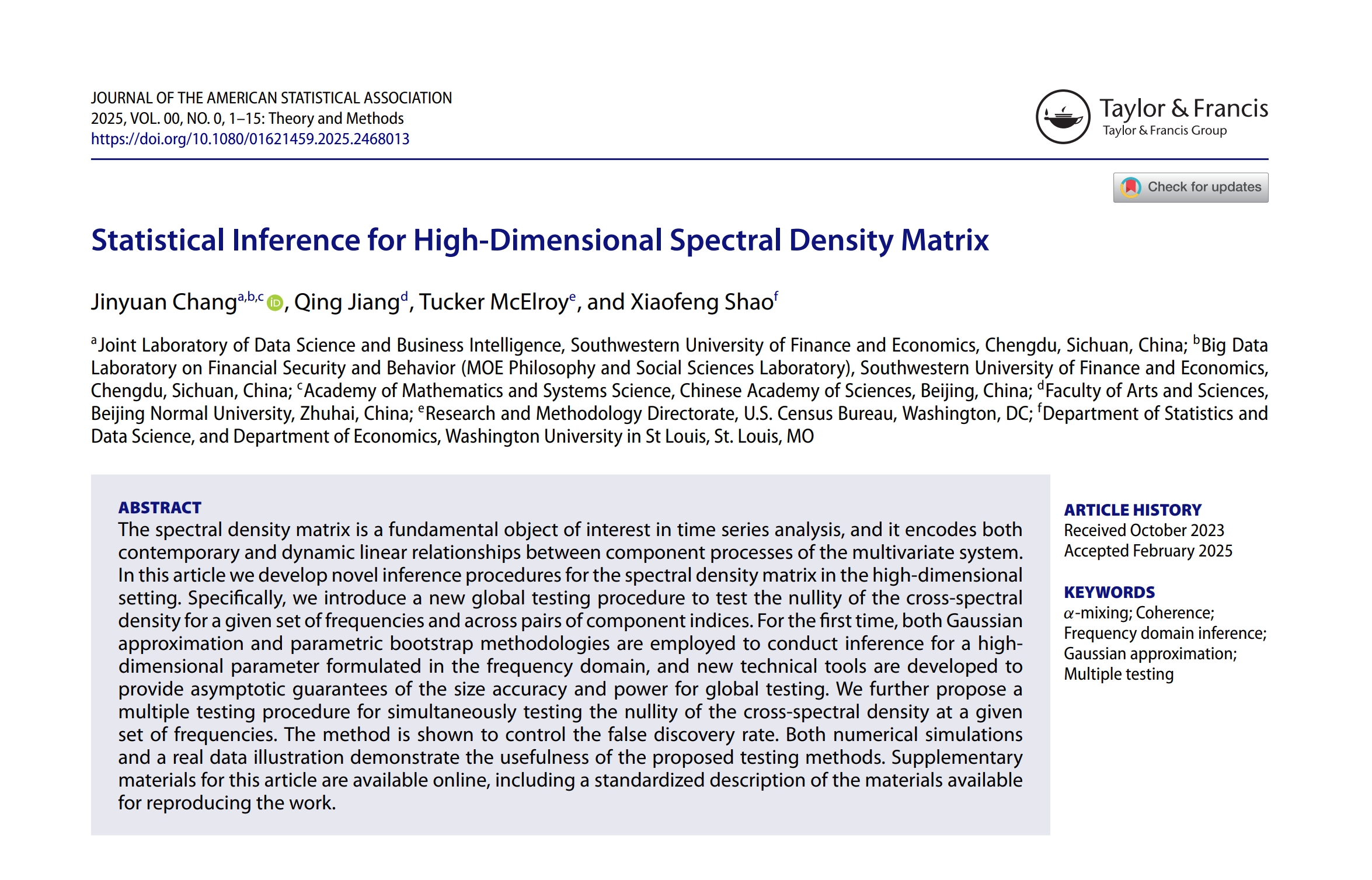
Chang, J., Jiang, Q., McElroy, T., & Shao, X. (2025+). Statistical inference for high-dimensional spectral density matrix. Journal of the American Statistical Association, in press.

The spectral density matrix is a fundamental object of interest in time series analysis, and it encodes both contemporary and dynamic linear relationships between component processes of the multivariate system. In this article we develop novel inference procedures for the spectral density matrix in the high-dimensional setting. Specifically, we introduce a new global testing procedure to test the nullity of the cross-spectral density for a given set of frequencies and across pairs of component indices. For the first time, both Gaussian approximation and parametric bootstrap methodologies are employed to conduct inference for a highdimensional parameter formulated in the frequency domain, and new technical tools are developed to provide asymptotic guarantees of the size accuracy and power for global testing. We further propose a multiple testing procedure for simultaneously testing the nullity of the cross-spectral density at a given set of frequencies. The method is shown to control the false discovery rate. Both numerical simulations and a real data illustration demonstrate the usefulness of the proposed testing methods. Supplementary materials for this article are available online, including a standardized description of the materials available for reproducing the work.

Read More »

Chang, J., Fang, Q., Qiao, X., & Yao, Q. (2025). On the modeling and prediction of high-dimensional functional time series. Journal of the American Statistical Association, 120, 2181-2195.

We propose a two-step procedure to model and predict high-dimensional functional time series, where the number of function-valued time series p is large in relation to the length of time series n. Our first step performs an eigenanalysis of a positive definite matrix, which leads to a one-to-one linear transformation for the original high-dimensional functional time series, and the transformed curve series can be segmented into several groups such that any two subseries from any two different groups are uncorrelated both contemporaneously and serially. Consequently in our second step those groups are handled separately without the information loss on the overall linear dynamic structure. The second step is devoted to establishing a finite-dimensional dynamical structure for all the transformed functional time series within each group. Furthermore the finite-dimensional structure is represented by that of a vector time series. Modeling and forecasting for the original high-dimensional functional time series are realized via those for the vector time series in all the groups. We investigate the theoretical properties of our proposed methods, and illustrate the finite-sample performance through both extensive simulation and two real datasets. Supplementary materials for this article are available online, including a standardized description of the materials available for reproducing the work.

Read More »

Chen, X., Deng, C., He, S., Wu, R., & Zhang, J. (2024). High-dimensional sparse single-index regression via Hilbert-Schmidt independence criterion. Statistics and Computing, 34, 86.

Hilbert-Schmidt Independence Criterion (HSIC) has recently been introduced to the field of single-index models to estimate the directions. Compared with other well-established methods, the HSIC based method requires relatively weak conditions. However, its performance has not yet been studied in the prevalent high-dimensional scenarios, where the number of covariates can be much larger than the sample size. In this article, based on HSIC, we propose to estimate the possibly sparse directions in the high-dimensional single-index models through a parameter reformulation. Our approach estimates the subspace of the direction directly and performs variable selection simultaneously. Due to the non-convexity of the objective function and the complexity of the constraints, a majorize-minimize algorithm together with the linearized alternating direction method of multipliers is developed to solve the optimization problem. Since it does not involve the inverse of the covariance matrix, the algorithm can naturally handle large p small n scenarios. Through extensive simulation studies and a real data analysis, we show that our proposal is efficient and effective in the high-dimensional settings. The Matlab codes for this method are available online.

Read More »

Chang, J., Hu, Q., Liu, C., & Tang, C. Y. (2024). Optimal covariance matrix estimation for high-dimensional noise in high-frequency data. Journal of Econometrics, 239, 105329.

We consider high-dimensional measurement errors with high-frequency data. Our objective is on recovering the high-dimensional cross-sectional covariance matrix of the random errors with optimality. In this problem, not all components of the random vector are observed at the same time and the measurement errors are latent variables, leading to major challenges besides high data dimensionality.

Read More »

Chang, J., Chen, C., Qiao, X., & Yao, Q. (2024). An autocovariance-based learning framework for high-dimensional functional time series. Journal of Econometrics, 239, 105385.

Many scientific and economic applications involve the statistical learning of high-dimensional functional time series, where the number of functional variables is comparable to, or even greater than, the number of serially dependent functional observations. In this paper, we model observed functional time series, which are subject to errors in the sense that each functional datum arises as the sum of two uncorrelated components, one dynamic and one white noise.

Read More »